
Tire selection is a vital safety and efficiency decision. Our guide details the fundamental distinctions between Truck Bus Radial (TBR) and Passenger Car Radial (PCR) tires to ensure you choose correctly.)

- What to Search For: “Giant commercial truck tire beside family SUV tire”
- Description: A side-by-side shot emphasizing the staggering difference in volume, tread depth, and sidewall thickness between the two tire classes.
When shopping for new tires, the physical contrast between those designed for commercial vehicles and those for everyday cars is impossible to miss. But the divergence goes far beyond mere dimensions. Truck Bus Radial (TBR) and Passenger Car Radial (PCR) tires are purpose-built from the inside out for entirely unique roles and demands.
Selecting an incorrect tire type doesn’t just hamper performance—it introduces significant safety hazards. This guide will explore the core design philosophies, structural makeup, and intended functions of TBR and PCR tires, clarifying why they are never interchangeable.
The Fundamental Divide: A Quick Overview
- Passenger Car Tires (PCR): Engineered for a plush, quiet, and responsive driving experience for lighter vehicles with fewer occupants and minimal cargo.
- Truck & Bus Tires (TBR): Constructed for ultimate resilience, exceptional load-bearing capability, and extended service life under relentless, heavy-duty conditions.
- Core Objective: Function and Use Case
PCR Tires: The principal goal of a passenger tire is to deliver a serene, smooth, and comfortable journey for its occupants. They are tailored for vehicles such as sedans, coupes, SUVs, and crossover utilities that mainly transport people and light goods on paved surfaces at standard highway velocities.
TBR Tires: The objective of a commercial truck or bus tire is entirely economic: to transport substantial payloads across vast distances, frequently for millions of miles, to maximize profitability. They are crafted for non-stop operation, withstanding tremendous weights, and delivering outstanding longevity to reduce running expenses. This encompasses long-haul tractors, freight trucks, and city buses.
- Engineered for Burden: Load Rating and Strength
This represents the most crucial engineering distinction.
PCR Tires: are manufactured to manage the mass of a vehicle and its passengers. A common PCR tire may feature a load index between 90 and 110, equating to a capacity of approximately 1,323 to 2,337 lbs (600 – 1,060 kg) for each tire.
TBR Tires: are extraordinarily fortified to manage immense tonnage. An individual commercial tire can possess a load index from 140 to 150, enabling it to bear between 11,023 and 13,227 lbs (5,000 – 6,000 kg) per tire. This remarkable fortitude is essential for commercial rigs operating at maximum legal weights of 80,000 lbs or more.
{Image Suggestion}
- What to Search For: “Extreme close-up tire sidewall load index numbers comparison”
- Description: A macro photo clearly showing the load index number on a PCR tire (e.g., 95) and another on a TBR tire (e.g., 148).
- Under the Surface: Structural Build Quality
Although both are radial in construction (with internal cords running perpendicular to the direction of travel), their builds are starkly different.
PCR Tires: Generally consist of a lighter-weight body with fewer steel belts and polyester layers. The priority is pliability to absorb road imperfections.
TBR Tires: Are extraordinarily tough. Their architecture includes:
- Heavier-Gauge Steel Belts: Several, thicker steel belts are incorporated to repel penetrations and evenly spread out extreme forces.
- More Durable Carcass: Frequently constructed with tougher substances such as steel cord or high-strength textile plies.
- Fortified Sidewalls: TBR sidewalls are considerably more substantial and rigid to minimize deformation and buckling under severe loads, particularly when turning.
Expert Insight: This heavy-duty build quality is the reason TBR tires are prime candidates for retreading—their underlying casing is engineered to survive for several tread lives, offering an economical and eco-friendly solution.
- Tread Pattern and Wear Life
A single glance at the tread reveals the difference in intent.
PCR Tires: Utilize diverse tread designs fine-tuned for grip in rain and sunshine, ejecting water to avoid hydroplaning, and ensuring a hushed cabin. New tread depth usually measures between 9/32″ and 11/32″.
TBR Tires: The tread philosophy is centered on wear life and toughness.
- Increased Tread Depth: TBR tires begin with a profoundly deeper tread, often 18/32″ to 32/32″, intended to gradually wear over hundreds of thousands of miles.
- Heavy-Duty Patterns: The tread lugs are bigger, more solid, and engineered to withstand tearing and abrasion from contacting curbs and dock edges.
- Rubber Formulation: The compound is tougher and more resistant to wear, trading off some grip for phenomenal mileage.
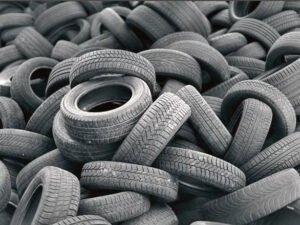
- What to Search For: “Comparison of car tire tread pattern vs truck tire tread”
- Description: A top-down view comparing the intricate, multi-grooved pattern of a PCR tire to the deep, large-block pattern of a TBR tire.
- Financial Perspective: Upfront Expense vs. Long-Term Value
PCR Tires: Consumers purchase a set of four. The cost is a direct retail expense, with replacement typically expected every 40,000-60,000 miles.
TBR Tires: A fleet manager buys tires in large volumes (e.g., 18 for a trailer). The initial outlay is substantial, but it’s viewed as a capital investment. The key metric is cost-per-mile. A premium TBR tire that undergoes multiple retreads delivers a significantly lower cost-per-mile over its total lifespan compared to a budget-friendly new tire.
FAQ: Is Using Truck Tires on a Personal Vehicle Advisable?
This is a frequent query among pickup truck and large SUV owners. It’s critical to note that while Light Truck (LT) tires are a middle ground, genuine commercial-grade TBR tires (typically marked with a size ending in ‘.5’, like 22.5″) are ill-suited for personal use.
- Comfort: The driving experience will be jarring, loud, and unpleasant.
- Control: The inflexible sidewalls can impair handling, stability, and braking efficiency on lighter vehicles.
- Mass: Their excessive weight places added stress on the vehicle’s suspension, brakes, and drivetrain components.
- Security: It is a hazardous practice and is strongly discouraged. Always adhere to the tire specifications provided by your vehicle’s manufacturer.
Summary: A Side-by-Side Comparison
| Feature | Passenger Car Radial (PCR) | Truck & Bus Radial (TBR) |
| Primary Goal | Comfort, Handling, Safety | Durability, Load Capacity, Mileage |
| Load Capacity | Lower | Exceptionally High |
| Tread Depth | Moderate (9/32″ – 11/32″) | Significant (18/32″ – 32/32″) |
| Build Quality | Lighter, more compliant | Heavier, steel-reinforced |
| On-Road Feel | Comfortable and Quiet | Firm and Noisy |
| Economic View | Retail Price | Cost-Per-Mile |
| Retreadability | Uncommon | Standard Practice |
Final Thoughts:
Grasping the distinction between TBR and PCR tires comes down to recognizing their intended operation. One is optimized for passenger comfort, the other for commercial productivity. Selecting the appropriate tire for your specific application is the cornerstone of safety, vehicle performance, and long-term financial savings.
Need help navigating the right tire choice for your needs? [Reach out to our specialists today] for a tailored consultation and quote!