
Concerned about the radial tires of a passenger car? Our comprehensive guide covers how they operate, the advantages they have over older bias-ply tires, important characteristics to consider, and how to maintain them for a smoother, safer ride.
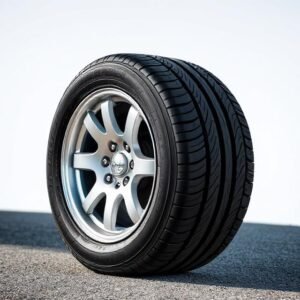
One of the most significant engineering advancements in automotive history is the passenger car radial tire, which you are riding on if you drive a modern vehicle. Radials are intricate wonders that are intended to keep you safe, increase your fuel efficiency, and provide a comfortable ride, despite their seemingly straightforward black circle appearance.
However, what are radial tires exactly, and why are they currently the industry standard? Everything you need to know will be broken down in this comprehensive guide.
A passenger car radial tire: what is it? (Basic Anatomy)
We must examine the past in order to comprehend why this is so revolutionary. Radial vs. Bias-Ply:
The Driving Revolution The majority of cars had bias-ply tires prior to the 1970s. The cord plies in these tires were arranged diagonally, with each ply crisscrossing the one before it, at an angle of roughly 30 to 45 degrees. This produced a strong, rigid structure, but it had several disadvantages: • Stiff Ride: The vehicle experienced more road shock due to the rigid construction. • Improper Handling: When cornering, the tread twisted and warped, decreasing traction. • Quick Wear: The tread’s scrubbing action caused wear to occur more quickly and unevenly. These issues were resolved with the advent of radial tires. This is a brief table of comparisons:
The Main Advantages of Using Contemporary Radial Tires
Why is this technology important to you as a car owner? Every time you get behind the wheel, the advantages are evident. 1. Better Fuel Economy: A radial tire’s flexible sidewalls expand the “contact patch” with the road. However, the tread doesn’t wriggle too much because steel belts stabilize it. Because there is less rolling resistance, your engine needs to work less to move the car, which saves you gas money. 2. Extended Tread Life: The stiff steel belts beneath the tread stop the distortion and scrubbing that led to bias-ply tires wearing out too soon. With the right care, modern radial tires can easily last between 40,000 and 80,000 miles.
3. Improved Safety and Handling: The tire can keep a steady contact with the road, particularly when braking and cornering, thanks to the independent movement of the tread and sidewall. This results in improved control during emergencies and shorter stopping distances on both dry and wet roads. 4. Better Ride Comfort: Radial tires’ flexible sidewalls serve as cushions, absorbing shocks and irregularities in the road much more effectively than rigid bias-ply tires. You and your passengers enjoy a more comfortable, quieter, and smoother ride as a result.
A Feature-by-Feature Analysis of the Sidewall
Your radial tire’s sidewall is similar to its biography. Making an informed purchase can be facilitated by being aware of the codes. Let’s break down a typical example: 94V P215/60R16 • P: Passenger car. • 215: Millimeters of Section Width. • 60: Aspect Ratio, which represents the sidewall height as a proportion of width. A tire with a lower number has a lower profile. • R: The most crucial letter, radial construction. • 16: Inches of rim diameter. • 94: Load Index (the highest weight that the tire is capable of bearing). • V: Speed Rating (the fastest safe speed the tire can maintain).
Selecting the Proper Radial Tire for Your Vehicle

Radial tires are not all created equal. They are designed to serve various functions: • Touring tires: Perfect for the majority of crossover SUVs and family sedans. Their main priorities are long tread life, quiet riding, and all-season performance. Performance tires are made for sports cars and high-performance sedans. At the expense of some tread life, they have softer compounds and unique tread patterns for optimal handling and grip. • All-terrain tires: Designed for trucks and SUVs, these provide a balance between off-road capability and on-road comfort. • Winter tires versus all-season tires: Dedicated winter tires use unique rubber compounds that remain flexible in freezing temperatures for significantly better traction in snow and ice, while most “all-season” tires are a decent compromise.
Tips for Maintaining Your Radial Tires To maximize your investment, adhere to these easy maintenance guidelines: • Every month, check the tire pressure: Uneven wear, increased rolling resistance (which reduces fuel efficiency), and the potential for overheating and blowout are all consequences of underinflated tires. Tires that are overinflated lose grip and prematurely deteriorate in the middle of the tread. Rotate your tires on a regular basis. Observe the manufacturer’s recommendation for your car, which is typically every 5,000–8,000 miles. This encourages uniform tire wear on all four tires. • Check Alignment: Get a wheel alignment if your steering wheel is off-center or your car pulls to one side. Tires that are misaligned quickly deteriorate.
Use the “penny test” to keep an eye on tread depth. Lincoln’s head upside down, insert a penny into the tread. You need new tires because your tread is too low (below 2/32″) if you can see the top of his head.
In conclusion, the obvious option for contemporary driving We frequently take for granted the engineering marvel that is the passenger car radial tire. Its distinctive design offers an unrivaled blend of durability, comfort, efficiency, and safety. You can make sure you’re getting the most out of your car’s sole point of contact with the road by knowing how they operate and how to maintain them.
https://www.facebook.com/profile.php?id=61567104654445
@guruscrap
https://www.youtube.com/@Guruscrap